At a Glance
- Original Medicare: It generally does not cover routine rides to medical appointments by car, taxi, rideshare, or wheelchair-accessible van.
- Limited ambulance coverage: Medicare Part B may cover medically necessary non-emergency ambulance transportation when another form of transportation could endanger the patient.
- Medicare Advantage: Some plans offer transportation as an additional benefit, but trip limits, distance limits, networks, destinations, and scheduling rules vary.
- Medicare and Medicaid together: A person can qualify for both programs, with Medicare generally paying first and Medicaid providing eligible secondary benefits.
- Health First Colorado NEMT: Eligible members who lack other transportation may receive rides to covered medical services without paying a normal passenger fare.
- Working with a disability: Colorado has a Medicaid Buy-In Program for certain working adults with disabilities who may otherwise earn too much for standard Medicaid.
- Applying for coverage: Colorado residents can apply through PEAK, by phone, through the mail, or with help from their county Department of Human Services.
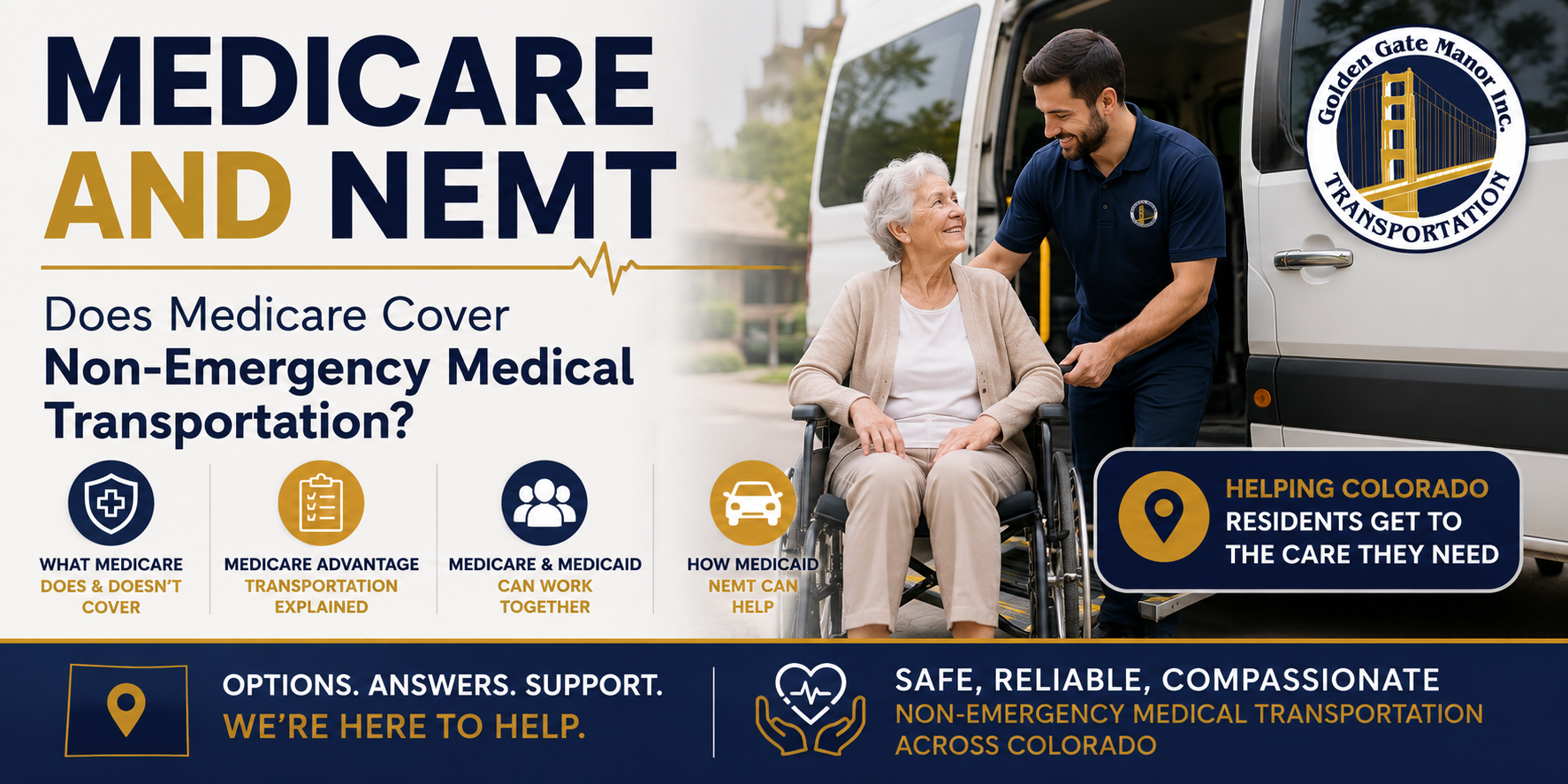
The direct answer is that Original Medicare generally does not cover routine Non-Emergency Medical Transportation. Having Medicare does not normally provide a ride by sedan, taxi, rideshare, public transportation, or wheelchair-accessible van simply because someone has a medical appointment.
There are two important exceptions to understand. Medicare Part B may cover medically necessary ambulance transportation in limited circumstances, and some Medicare Advantage plans include transportation as an additional plan benefit. Neither option provides the same broad medical transportation benefit available to eligible Health First Colorado members.
This is also where Medicare and Medicaid are frequently confused. They are separate programs with different eligibility requirements and covered benefits. A service covered by Medicaid is not automatically covered by Medicare.
Does Original Medicare Cover NEMT?
Original Medicare does not provide a general NEMT benefit for routine medical appointments. A person cannot ordinarily submit the cost of a taxi, rideshare, private medical ride, or wheelchair van to Original Medicare simply because the trip was necessary to see a doctor.
This means Original Medicare generally will not pay for routine transportation to:
- Primary care appointments
- Specialist appointments
- Physical or occupational therapy
- Behavioral health appointments
- Dental appointments
- Pharmacies
- Dialysis appointments when ambulance transportation is not medically required
- Routine testing, imaging, or laboratory visits
The appointment itself may be covered even though transportation to the appointment is not. Medicare coverage for the healthcare service and coverage for the ride are two separate decisions.
For more information about how different medical transportation options are priced, see our guide to non-emergency medical transportation costs in Colorado.
Medicare May Cover a Non-Emergency Ambulance
Medicare Part B may cover limited, medically necessary non-emergency ambulance transportation. This applies when using another form of transportation could endanger the patient’s health and ambulance transportation is required because of the person’s medical condition.
A healthcare provider may need to write an order explaining why an ambulance is medically necessary. Even with an order, the transportation must still meet Medicare’s coverage requirements.
Examples may include a person who:
- Requires medical monitoring during transportation
- Cannot be safely transported while sitting in an ordinary vehicle
- Requires positioning or medical care that only an ambulance can provide
- Needs repeated scheduled ambulance transportation for a qualifying medical condition
- Could experience a serious health risk if transported by car, taxi, or wheelchair van
Medicare generally covers transportation only to the nearest appropriate facility capable of providing the needed care. Choosing a more distant facility for personal preference may leave the patient responsible for the additional transportation cost.
When Medicare covers the ambulance trip, the patient generally owes the Part B deductible and 20% of the Medicare-approved amount. Secondary insurance or Medicaid may help with eligible cost-sharing.
A non-emergency ambulance and ordinary NEMT are not the same service. Ambulances are medically equipped and used when the person cannot be transported safely through a less intensive transportation option.
What About Medicare Advantage Transportation?
Medicare Advantage plans, also called Medicare Part C plans, must cover the Medicare Part A and Part B services covered by Original Medicare. Private insurance companies offering these plans may also provide additional benefits that Original Medicare does not include.
Some Medicare Advantage plans offer transportation to medical appointments as a supplemental benefit. However, not every plan includes transportation, and the presence of a transportation benefit does not mean the member has unrestricted NEMT coverage.
A plan may establish rules involving:
- A fixed number of one-way trips each year
- Mileage or service-area limits
- Specific approved medical destinations
- An approved transportation company or network
- Advance scheduling requirements
- Prior authorization
- Vehicle or accessibility restrictions
- Separate rules for return transportation
- Copayments or other member costs
- Eligibility limited to members with certain conditions
These benefits can be difficult to understand from an insurance card alone. Members should review their plan’s Evidence of Coverage or speak directly with member services before relying on transportation for an important appointment.
CMS requires Medicare Advantage plans to explain the scope of available supplemental benefits, applicable cost-sharing, instructions for accessing the benefit, and relevant network information. The details can still vary considerably from one plan to another.
Medicare and Medicaid Transportation Compared
The following table explains the major differences. It is a general overview, and the actual decision depends on the member’s plan, medical condition, eligibility, and trip details.
| Coverage type | Routine NEMT | Common limitations | Possible patient cost |
|---|---|---|---|
| Original Medicare | Generally not covered | Routine cars, taxis, rideshares, and wheelchair vans are not a standard benefit | Patient generally pays the full routine ride cost |
| Medicare non-emergency ambulance | May be covered in limited circumstances | Another form of transportation must endanger the patient’s health; medical necessity must be documented | Part B deductible and generally 20% coinsurance |
| Medicare Advantage | Some plans offer transportation | Benefits may have trip, distance, destination, scheduling, accessibility, or network limits | Depends on the individual plan |
| Health First Colorado | NEMT may be covered for eligible members | Member must qualify, lack another means of transportation, and travel to a covered service | Generally no normal passenger fare for an approved trip |
Questions to Ask a Medicare Advantage Plan
Calling the plan before the appointment can prevent missed rides and unexpected costs. Ask for clear answers and request the applicable section of the Evidence of Coverage when possible.
Useful questions include:
- Does my current plan include transportation to medical appointments?
- Is this a standard plan benefit or a supplemental benefit?
- How many one-way rides do I receive each year?
- Is there a mileage or geographic limit?
- Which medical destinations are covered?
- Must I use a particular transportation company?
- How far in advance must I schedule?
- Does the benefit provide wheelchair-accessible transportation?
- Can an attendant or caregiver ride with me?
- How is the return trip arranged if the appointment runs late?
- Do I need prior authorization or a referral?
- Is there a copayment or other out-of-pocket cost?
- Does an unused ride expire at the end of the year?
- Where can I find these rules in my plan documents?
Do not rely only on the phrase “transportation included.” A useful benefit must also accommodate the distance, appointment type, mobility needs, timing, and return trip.
Health First Colorado Provides a Broader NEMT Benefit
Health First Colorado is Colorado’s Medicaid program. Its Non-Emergency Medical Transportation benefit helps eligible members who do not have another way to reach medically necessary services covered by Health First Colorado.
Covered transportation can include different modes depending on the member’s needs and the trip. Colorado’s NEMT program recognizes options such as public transportation, mileage reimbursement, ambulatory vehicles, taxis, wheelchair vans, stretcher vans, and medically necessary ambulance transportation.
The program may support transportation to covered services such as:
- Medical and specialist appointments
- Physical and occupational therapy
- Behavioral health treatment
- Dialysis
- Diagnostic testing
- Pharmacy services connected to covered care
- Hospital admissions and discharges
- Other medically necessary Health First Colorado services
The requested transportation must still meet Medicaid requirements. Being enrolled in Health First Colorado does not automatically make every destination or every requested vehicle covered.
More information about this benefit is available through our Non-Emergency Medical Transportation resource page.
You Can Have Medicare and Medicaid at the Same Time
A common misunderstanding is that receiving Medicare makes someone ineligible for Medicaid. A person who meets the applicable requirements can have both Medicare and full-benefit Medicaid coverage.
People with both are commonly called dual eligible. Medicare generally pays first for Medicare-covered services, and Medicaid processes eligible costs or services after Medicare and any other insurance.
Depending on the person’s Medicaid eligibility, Health First Colorado may help with:
- Medicare premiums
- Deductibles
- Copayments and coinsurance
- Services that Medicare does not cover
- Medical supplies or equipment covered more broadly by Medicaid
- Long-term services and supports
- Medicaid-covered NEMT
Not every program that helps with Medicare expenses provides full Medicaid benefits. A Medicare Savings Program, for example, may assist with premiums or cost-sharing without necessarily providing the full Health First Colorado benefit package that includes NEMT.
Anyone receiving assistance with Medicare costs should verify whether they have full-benefit Health First Colorado and whether their benefit plan includes Non-Emergency Medical Transportation.
Three Medicaid Eligibility Paths to Investigate
Medicaid eligibility is determined by the state or county eligibility agency rather than by a medical provider or transportation company. Colorado has several pathways, but three are especially relevant to people who already have Medicare or need transportation to ongoing medical care.
Standard Health First Colorado Eligibility
Some Colorado adults qualify for Health First Colorado based largely on household size and income. The application reviews the applicant’s household, income, residency, citizenship or qualifying immigration status, and other relevant circumstances.
For many standard adult and family categories, Colorado uses Modified Adjusted Gross Income, or MAGI. MAGI is based on federal tax rules, but it is not necessarily identical to take-home pay, the amount deposited into a bank account, or a single line from a paycheck.
Tax filing relationships can also affect which people and income are included in the Medicaid household. Applicants should provide accurate information and allow the eligibility agency to determine which rules apply.
Buy-In Program for Working Adults With Disabilities
Some people living with a disability assume that working automatically prevents them from receiving Medicaid. Colorado’s Buy-In Program for Working Adults with Disabilities is specifically intended for qualifying adults who work and may earn too much for standard Health First Colorado.
The program generally requires the applicant to:
- Be at least 16 years old
- Be working
- Meet the program’s disability requirements
- Have income after applicable disregards below the program limit
- Complete any required disability documentation
- Pay a monthly premium when applicable
Colorado currently sets the income limit using a percentage of the federal poverty level after permitted income disregards. Because those limits and premiums can change, applicants should use the current Health First Colorado program information rather than relying on an old dollar figure.
The program may be useful for someone who works but needs broader medical benefits, help with Medicare-related expenses, or access to Medicaid-covered transportation. Enrollment does not guarantee every requested trip, but qualifying for the appropriate full-benefit Health First Colorado program may provide access to NEMT.
Dual Eligibility for Medicare and Medicaid
People who are older adults, receive Medicare because of a disability, or otherwise meet Colorado’s Medicaid rules may qualify for both programs. Financial rules for aged, blind, or disability-related Medicaid categories can differ from the MAGI rules used for many standard adult applicants.
This is why a person should not assume they are ineligible based only on taxable income, Social Security income, employment, or Medicare enrollment. The correct eligibility category may apply different income disregards, resource limits, disability requirements, or premium rules.
How Medicaid Reviews Income
It is reasonable to describe some Medicaid eligibility as being connected to taxable income, but that phrase alone is incomplete. Many standard Health First Colorado categories use MAGI, which starts with federal tax concepts and considers household composition.
Other Medicaid pathways do not use MAGI. Programs based on age, blindness, disability, long-term care, or the Working Adults with Disabilities Buy-In can apply different methodologies.
Income that may need to be reported includes:
- Wages and self-employment income
- Social Security or disability payments
- Retirement or pension income
- Unemployment compensation
- Investment or rental income
- Other earned and unearned income requested on the application
Some income may be excluded or disregarded under the rules for a particular program. The safest approach is to report the requested information accurately rather than deciding independently that income is or is not taxable or countable.
Medicaid eligibility is not determined from take-home pay alone. The eligibility agency applies the financial rules for the program category that fits the applicant’s circumstances.
How to Apply for Health First Colorado
Colorado residents can apply online through Colorado PEAK. Applications can also be completed by phone, through the mail, in person at a county Department of Human Services, or with help from an approved application-assistance site.
A basic application process looks like this:
- Submit the Health First Colorado application.
- Report everyone in the household and the requested tax-filing relationships.
- Provide current income and insurance information.
- Identify any disability, Medicare enrollment, or need for long-term support.
- Submit additional disability forms if requested.
- Respond to requests for verification or missing information.
- Review the eligibility notice to see which program and benefit plan were approved.
Applicants interested in the Working Adults with Disabilities Buy-In may need to submit a separate disability application when they do not already have a qualifying Social Security disability determination.
What to Gather Before Applying
Not every applicant will need every document listed below. Having the information available can make it easier to complete the application and respond to verification requests.
Consider gathering:
- Social Security numbers for applicants
- Dates of birth
- Colorado address and contact information
- Citizenship or qualifying immigration documents when requested
- Medicare card and Medicare Advantage plan information
- Information about other health insurance
- Recent pay stubs
- Self-employment income and expense records
- Social Security, disability, pension, or retirement award letters
- Tax-filing information
- Employer information
- Disability determination or medical documentation
- Information about household members
- Documentation requested by the county or eligibility site
An application should still be submitted when someone is uncertain about eligibility. The state or county agency—not a transportation provider—makes the final determination.
Common Medicare and Medicaid Transportation Misunderstandings
The most common source of confusion is treating Medicare and Medicaid as if they cover the same services. They do not.
“Medicaid Covers It, So Medicare Must Cover It”
Medicaid programs are required and administered differently from Medicare. Health First Colorado can cover medical transportation even though Original Medicare does not provide a comparable routine NEMT benefit.
The reverse can also occur. A service covered under Medicare rules may not automatically be payable under every Medicaid benefit plan or circumstance.
“I Have Medicare, So My Medical Ride Is Covered”
Original Medicare coverage of the appointment does not include an ordinary ride to that appointment. Transportation must have its own coverage basis.
A medically necessary ambulance may qualify under narrow circumstances. A routine sedan, taxi, rideshare, or wheelchair-van trip generally does not qualify under Original Medicare.
“Medicare Advantage Transportation Is the Same as Medicaid NEMT”
A Medicare Advantage transportation benefit is created and administered by the individual insurance plan. It may have a limited annual allowance, approved network, destination restrictions, or scheduling requirements.
Health First Colorado NEMT is a Medicaid benefit governed by Colorado Medicaid eligibility and transportation rules. The two should not be treated as interchangeable.
“Having Medicare Means I Cannot Get Medicaid”
Medicare and Medicaid can be held at the same time. Applicants must still meet Colorado’s applicable financial and nonfinancial requirements.
Full-benefit Medicaid may cover eligible services that Medicare does not provide, including Non-Emergency Medical Transportation. Medicare Savings Program assistance alone may not include the same benefits.
“Every Doctor’s Appointment Qualifies for a Ride”
Under Health First Colorado, the service generally must be covered and provided by an appropriately enrolled medical provider. The member must also meet the transportation benefit’s requirements.
A medical destination does not automatically establish coverage. The purpose of the appointment, provider status, transportation need, distance, and requested mode may all matter.
Finding the Right Next Step
Someone with Original Medicare should first check whether they have a Medicare Advantage plan and whether that specific plan includes transportation. Asking detailed questions is important because an advertised transportation benefit may not accommodate the actual trip.
A Colorado resident with limited income, a disability, or significant medical transportation needs should also investigate Health First Colorado eligibility. Medicare enrollment does not prevent Medicaid eligibility, and working does not automatically exclude someone from the Working Adults with Disabilities Buy-In Program.
Golden Gate Manor Transportation provides educational information about Non-Emergency Medical Transportation and the differences between transportation options. Readers comparing private-pay services, Medicaid NEMT, public transit, taxis, or rideshare can also review our article about medical transportation costs in Colorado.
The most important step is to verify coverage before relying on a ride for an appointment. Confirm the exact Medicare Advantage benefit, submit a Health First Colorado application when appropriate, and make sure the requested trip meets the rules of the program expected to pay for it.
- Medicare Ambulance Services Coverage
- Medicare Coverage of Ambulance Services
- CMS Medicare Advantage Supplemental Benefit Requirements
- Medicare and Medicaid Dual Eligibility
- Health First Colorado Non-Emergency Medical Transportation
- Health First Colorado NEMT Billing Manual
- Health First Colorado Buy-In for Working Adults With Disabilities
- Health First Colorado Application Forms and PEAK
- Health First Colorado MAGI Household Composition Guide