At a Glance
- Coverage is item-specific: An insurance plan may cover DME generally while excluding the exact product, model, quantity, or replacement being requested.
- A prescription is only the beginning: Medical notes, diagnosis information, billing codes, supplier enrollment, and prior authorization may also be required.
- Commercial insurance varies by plan: Networks, deductibles, copayments, preferred suppliers, and authorization rules can differ significantly.
- Medicare follows Part B rules: Covered DME must be medically necessary, ordered for home use, and provided by an appropriately enrolled supplier.
- Health First Colorado uses code-level requirements: Some equipment and disposable supplies require prior authorization, supporting documentation, and compliance with quantity or replacement limits.
- Covered does not always mean free: Deductibles, copayments, coinsurance, noncovered upgrades, and rental arrangements may create patient responsibility.
- Starting early matters: Begin insurance-covered equipment requests several business days before discharge whenever possible.
- Cash, HSA, or FSA may be alternatives: A patient may still purchase an item when insurance does not cover it or when waiting for insurance is not practical.
The direct answer is that you cannot determine Insurance Coverage of DME from the product name or prescription alone. Coverage depends on the exact equipment or supply, its HCPCS billing code, the medical reason it is needed, the documentation in the patient’s record, the insurance plan’s benefit rules, and whether the chosen DME supplier can bill that plan.
A prescription tells a medical supply company what the healthcare provider ordered. It does not guarantee that the insurance company will approve or pay for the item.
The most reliable way to check an individual request is to contact a qualified DME supplier with the patient’s insurance information, prescription, medical documentation, and requested product. The supplier can review whether the request is within its product scope and credentialed insurance networks before explaining the likely next steps.
How Insurance Coverage of DME Is Determined
Insurance companies do not normally make one broad decision that covers every type of medical equipment. They evaluate claims using several connected requirements.
A coverage review generally asks:
- Is the product included in the member’s benefit plan?
- Does the item have an appropriate HCPCS billing code?
- Does the diagnosis and medical record establish medical necessity?
- Has the prescribing provider supplied the required order and clinical notes?
- Is the DME supplier enrolled or in network with the payer?
- Does the item require prior authorization?
- Is the requested quantity, replacement frequency, or rental period allowed?
- Does the patient have a deductible, copayment, or coinsurance?
- Is another insurance company responsible for paying first?
- Is the requested model considered standard equipment or a noncovered upgrade?
These questions explain why asking, “Does my insurance cover wheelchairs?” may not produce a complete answer. A plan may cover a basic manual wheelchair while applying different rules to a reclining wheelchair, power wheelchair, custom seating system, or replacement chair.
The Exact Billing Code Matters
DME and medical supplies are commonly billed using Healthcare Common Procedure Coding System, or HCPCS, codes. The code helps identify what is being supplied and which coverage, pricing, authorization, and quantity rules apply.
Two products that look similar may be represented by different codes. The difference may involve size, features, power controls, accessories, absorbency, frequency of use, or the level of support the item provides.
The DME supplier must determine which code appropriately represents the item being dispensed. The insurance company then evaluates the claim or authorization request under the rules attached to that code.
Benefit Verification Is Not a Final Payment Guarantee
A benefit verification can help determine whether the plan appears to cover the product category, whether the supplier is in network, and what cost-sharing may apply. It is still not an unconditional promise that the final claim will be paid.
Final payment can depend on:
- Active coverage on the date of service
- Accurate coding
- Complete medical documentation
- Prior-authorization approval
- Quantity and replacement limits
- Coordination with other insurance
- Proof of delivery
- Continued medical need
- The terms of the patient’s specific plan
Health First Colorado also states that prior-authorization approval does not itself guarantee payment. The claim must still meet all other eligibility, billing, documentation, and program requirements.
Why a Prescription Does Not Guarantee Coverage
A healthcare provider’s role is to identify the patient’s medical condition and recommend appropriate treatment or equipment. The DME supplier’s role includes interpreting current billing codes, payer policies, documentation standards, network rules, authorization requirements, and product availability.
Most prescribing professionals are not expected to track every changing DME rule for every commercial plan, Medicare policy, or state Medicaid program. A provider may reasonably believe that a product would help the patient even when the patient’s insurance excludes it or requires documentation that is not yet in the medical record.
For Medicare claims, CMS documentation guidance requires more than the written order. The supplier may also need medical-record information, correct coding, proof of delivery, continued-use documentation, or a written order before delivery.
The prescribing provider is still essential to the process. However, the DME company receiving the order is usually the best source for current information about:
- Whether it provides the requested product
- Whether it works with the patient’s insurance
- Which documentation is missing
- Whether prior authorization is required
- Whether the item is ready to be dispensed
- What the patient may owe
- Whether a different supplier would be more appropriate
Insurance noncoverage does not mean that the patient is prohibited from obtaining the equipment. It means the insurance plan is not paying for it under the applicable benefit and claim circumstances. The patient may still consider a cash purchase, HSA or FSA payment, an alternative product, an appeal, or another supplier.
Commercial Insurance Coverage of DME
Commercial insurance includes employer-sponsored coverage, Marketplace plans, and individual private health plans. These plans may provide DME benefits, but the networks, authorization processes, covered products, cost-sharing, and preferred suppliers vary considerably.
Colorado patients may carry plans issued by companies such as Aetna, Anthem Blue Cross and Blue Shield, Cigna, Humana, UnitedHealthcare, or another commercial insurer. The company name alone does not establish whether a particular DME supplier is in network because the insurer may offer many different plan designs.
Commercial Plans May Use Restricted Supplier Networks
Some plans require members to use a specific national, regional, or mail-order DME supplier. Others maintain a smaller local network or divide product categories among different suppliers.
A plan may use one supplier for respiratory equipment, another for mobility equipment, and another for recurring disposable supplies. A local medical supply store may carry the requested product but still be unable to bill the patient’s particular plan.
Using an out-of-network supplier may result in:
- Higher patient costs
- No out-of-network DME benefit
- A denied authorization
- A requirement to pay upfront
- Reduced reimbursement
- The need to submit a claim personally
- Redirection to a preferred supplier
Before starting the order, ask both the insurance company and the DME supplier whether the supplier is in network for the exact plan and product category.
Commercial Prior Authorization Can Be Strict
Some commercial insurers require prior authorization for hospital beds, wheelchairs, patient lifts, compression products, wound supplies, or other equipment. Requirements may differ even among plans issued by the same insurance company.
The authorization may require:
- A detailed written order
- Recent clinical notes
- A diagnosis related to the requested equipment
- Documentation of functional limitations
- Measurements
- Evidence that less complex equipment was considered
- A trial or evaluation
- A letter of medical necessity
- Proof that the product will be used in the home
- An in-network supplier quotation
The DME company cannot submit a complete authorization request until it receives the required information. Missing clinical details can delay the request even when the prescription itself is already available.
Commercial Coverage May Include Significant Patient Costs
A commercial plan may cover the equipment while applying the patient’s annual deductible, copayment, or coinsurance. A high-deductible plan could leave the patient responsible for much of the allowed amount until the deductible is met.
The insurer may also cover only a standard model. Optional features, upgraded materials, preferred brands, or convenience features may remain the patient’s responsibility.
“Covered” means the plan recognizes the item as a potential benefit when its conditions are met. It does not necessarily mean that the patient will owe nothing.
Medicare Coverage of DME
Original Medicare Part B covers medically necessary DME ordered by an eligible healthcare provider for use in the patient’s home. Medicare also requires the equipment to be obtained from a Medicare-enrolled supplier.
Depending on the product, Medicare may purchase the item, rent it, allow a rental-or-purchase choice, or transfer ownership after a defined rental period. The exact payment method is connected to the product’s Medicare classification.
After the Part B deductible, the patient generally pays 20% of the Medicare-approved amount when the supplier accepts assignment. A nonparticipating supplier that does not accept assignment may charge differently or require upfront payment.
Medicare Requires Supporting Documentation
Medicare requires a written order, but the patient’s medical record must also support the coverage criteria for the requested item. The DME supplier reviews the records to determine whether the documentation reasonably supports payment before dispensing or billing the product.
The required documentation may include:
- Diagnosis information
- Functional limitations
- Relevant physical examination findings
- Treatment history
- Expected length of need
- Face-to-face encounter documentation
- Continued need or use
- Measurements
- Failed or inappropriate alternatives
- Product-specific medical criteria
A provider’s note stating only “patient needs wheelchair” may not contain enough information for a particular wheelchair claim. The record must explain the patient’s mobility limitation and why the requested equipment is appropriate.
Medicare Advantage Plans
Medicare Advantage plans must provide the applicable medically necessary DME categories covered by Original Medicare. However, the plan may use its own supplier network, prior-authorization process, copayments, coinsurance, and referral requirements.
Members should contact the plan before receiving equipment and ask whether the supplier is in network. The plan’s Evidence of Coverage should describe applicable DME cost-sharing and access rules.
A more detailed explanation of Original Medicare coverage, common exclusions, and costs is available in our guide to DME covered by Medicare.
Golden Gate Medical Supply’s Medicare Service Footprint
Golden Gate Medical Supply can evaluate qualifying Medicare requests within its NPE West enrollment footprint, subject to state licensing, product scope, delivery, shipping, documentation, and Medicare requirements. The NPE West region handles DMEPOS supplier enrollment for states west of the Mississippi River and certain U.S. territories.
Our ability to evaluate a request does not guarantee that we can supply every product in every location. Equipment requiring local installation, setup, fitting, education, repairs, or ongoing in-person support may need to be provided by a supplier closer to the patient.
Health First Colorado Medicaid Coverage
Health First Colorado is Colorado’s Medicaid program. It covers eligible durable medical equipment, prosthetics, orthotics, and medical supplies under code-specific rules published in the state’s DMEPOS billing manual and DME HCPCS code table.
Health First Colorado may cover certain equipment and disposable supplies that Original Medicare excludes. Coverage still depends on eligibility, medical necessity, documentation, authorization requirements, quantity limits, and the applicable billing code.
Prior Authorization Requests
Some Health First Colorado products require a Prior Authorization Request, commonly called a PAR. The DME supplier submits the required clinical documentation for review before dispensing the item when prior approval is required.
A PAR is not processed like a basic pharmacy claim that immediately returns a paid or denied response at the counter. The reviewer must evaluate whether the documentation satisfies the coverage criteria for the requested code, quantity, and period of need.
At Golden Gate Medical Supply, many complete PAR reviews take around seven business days in our experience. Actual timing varies, and Health First Colorado training materials indicate that a standard review may take up to 10 business days.
The review period begins only after the supplier can submit a complete request. Before that happens, the DME company may still be waiting for:
- The signed order
- Clinical notes
- Face-to-face documentation
- Diagnosis information
- Measurements
- Product questionnaires
- Length-of-need information
- Treatment history
- A provider signature
- Primary-insurance information
The supplier cannot responsibly submit incomplete information simply to start the clock. Missing documentation can result in a request for additional information or a denial.
Quantity and Replacement Limits
Health First Colorado may limit how much of a disposable supply can be provided during a defined period. It may also require additional documentation or authorization for quantities above a standard allowance.
Equipment replacement can be affected by:
- The age of the current equipment
- Whether the item is still functional
- Repair options
- Changes in the patient’s condition
- Loss or damage
- Whether the patient already received a similar item
- The program’s replacement rules
- Whether the equipment was purchased or rented
A covered product category does not guarantee approval of every model, accessory, quantity, or replacement request.
When a Patient Has Both Medicare and Medicaid
A patient can have Medicare and Health First Colorado at the same time. When an item falls under a Medicare benefit, Medicare is generally billed first.
For an Original Medicare item, Medicare commonly pays 80% of the approved amount after the Part B deductible. Health First Colorado may process eligible remaining cost-sharing under its secondary-payer rules.
When Medicare does not cover the requested product, the DME supplier may need Medicare to process or deny the claim before Medicaid can consider it. Medicaid then applies its own coverage, authorization, documentation, and billing requirements.
This means that a Medicare denial does not automatically produce Medicaid approval. The item must still qualify under Health First Colorado’s benefit rules.
How Coverage Varies by Product Category
Different products create different coverage questions. The following table provides a practical overview rather than a guarantee of payment.
| Product category | Common coverage questions | Documentation or limits commonly reviewed |
|---|---|---|
| Walkers and basic mobility aids | Is the device medically necessary for mobility in the home? Has a similar item already been provided? | Prescription, mobility limitation, home-use need, replacement history, and reasonable useful lifetime |
| Manual wheelchairs | Why will a cane or walker not meet the patient’s needs? Can the wheelchair be used in the home? | Medical notes, functional limitations, measurements, home use, and equipment history |
| Power mobility equipment | Does the patient meet the criteria for a power device rather than manual equipment? | Face-to-face evaluation, detailed mobility documentation, home assessment, measurements, and prior authorization |
| Hospital beds | Why can the patient’s positioning needs not be met in an ordinary bed? | Positioning requirements, frequency of changes, diagnosis, expected length of need, and bed type |
| Patient or Hoyer-style lifts | Can transfers occur safely without a lift? Would the patient otherwise be confined to a bed? | Transfer limitations, caregiver information, medical notes, diagnosis, and requested lift type |
| Ostomy supplies | Does the patient have a qualifying ostomy, and are the requested products and quantities medically appropriate? | Prescription, product types, quantities, refill timing, and continued need |
| Urological supplies | What catheter or drainage products are required, and how frequently are they used? | Diagnosis, product type, frequency, quantity, infection-related documentation when applicable, and refill timing |
| Incontinence supplies | Does the payer cover these products, and does the patient meet its eligibility criteria? | Diagnosis, size, product type, daily use, quantity limits, age requirements, and authorization rules |
| Wound care supplies | Does the wound and treatment plan support the exact dressing requested? | Wound type, size, drainage, frequency of changes, treatment notes, and product quantity |
| Compression products | Is the compression level and product type covered under the patient’s diagnosis and benefit? | Measurements, diagnosis, prescription, compression level, replacement frequency, and plan exclusions |
The same product may receive different decisions from commercial insurance, Medicare, and Health First Colorado. Each program evaluates the request under its own benefit and billing rules.
Covered Does Not Always Mean Free
Insurance coverage may reduce the cost of equipment without eliminating patient responsibility. The amount owed depends on the plan’s payment structure and the status of the patient’s deductible.
Important cost terms include:
- Deductible: The amount the patient pays before the plan begins paying for certain covered benefits.
- Copayment: A fixed amount the patient pays for a covered item or service.
- Coinsurance: A percentage of the allowed amount paid by the patient.
- Allowed amount: The price the insurer recognizes for the covered item.
- Noncovered upgrade: A feature or model that exceeds what the insurance plan considers medically necessary.
- Rental: Monthly insurance payments for equipment rather than an immediate purchase.
- Secondary insurance: Additional coverage that may process eligible patient responsibility after the primary insurer.
For example, suppose an insurer’s allowed amount for covered equipment is $500 and the plan applies 20% coinsurance after the deductible. The patient’s coinsurance would generally be $100, assuming the deductible has already been met and no other rules apply.
The retail price and insurance allowed amount may be different. The DME supplier should explain which amount is being used and what the patient may owe before delivery whenever possible.
Reasonable Useful Lifetime and Replacement Rules
Insurance can cover a type of equipment but still deny a replacement because the existing item is considered too new. This is commonly called the reasonable useful lifetime, or RUL.
Under Original Medicare, the reasonable useful lifetime for most DME cannot be less than five years. The period generally begins when the equipment is delivered to the beneficiary, not when the equipment was manufactured.
| Item or category | General Medicare replacement concept |
|---|---|
| Walkers and canes | Commonly subject to a five-year reasonable useful lifetime |
| Manual and power wheelchairs | Generally subject to reasonable-useful-lifetime rules and medical-necessity review |
| Hospital beds | Replacement due to ordinary wear is generally not covered during the reasonable useful lifetime |
| Patient lifts | A replacement may require proof that the current equipment reached its useful lifetime or can no longer meet the medical need |
| Oxygen equipment | Uses a separate 36-month rental-payment structure within a five-year equipment period |
| Recurring disposable supplies | Not governed by a five-year equipment lifetime, but refill dates and quantity limits apply |
Medicare may consider replacement before the end of the useful lifetime in cases such as loss or irreparable damage caused by a specific incident. A documented change in medical condition may also support a different type of equipment rather than a simple replacement of the same item.
During the equipment’s reasonable useful lifetime, repair may be considered before replacement. Commercial insurance and Health First Colorado may use different replacement schedules or additional requirements.
These rules are not created by the DME company to make the process more difficult. Suppliers must follow the payer’s replacement policies to avoid an improper claim or unexpected patient bill.
Refill Timing for Disposable Supplies
Ostomy, urology, incontinence, wound care, and other recurring products may have monthly or periodic quantity limits. Insurance may deny supplies requested too early even though the products are normally covered.
The supplier may need to confirm:
- How much product remains
- Whether the previous shipment was received
- The next eligible refill date
- Whether the prescription remains valid
- Whether the patient’s usage has changed
- Whether the requested quantity exceeds the plan allowance
- Whether additional documentation is needed
Do not assume that a larger prescription automatically overrides an insurance quantity limit. The supplier may need additional medical justification or authorization.
Why Insurance-Covered DME Takes Time
Insurance-covered equipment frequently requires coordination among the patient, healthcare provider, DME supplier, insurance company, and sometimes a hospital or discharge planner. Each organization holds a different part of the information needed to complete the order.
A simplified process usually looks like this:
- The supplier verifies insurance and network participation.
- The prescribing office sends the order and clinical notes.
- The supplier reviews the documentation and selects the appropriate billing code.
- Missing information is requested from the provider.
- Prior authorization is submitted when required.
- The insurer reviews the request.
- The supplier confirms patient responsibility and product availability.
- The item is ordered, shipped, delivered, assembled, fitted, or demonstrated as appropriate.
Patients do not need to understand every billing step. They should understand that the DME company cannot move to the next stage until the required information from the prior stage is available.
Start Before the Discharge Date
Beginning the DME process on the day of discharge may not leave enough time to obtain medical records, verify insurance, complete prior authorization, and arrange delivery. Whenever possible, begin the request three to seven business days before the planned discharge.
More complex equipment may require additional time. Power mobility devices, custom products, specialized beds, and equipment requiring home evaluation or extensive documentation can take longer.
Starting early does not guarantee approval by the discharge date. It gives the supplier a more realistic opportunity to identify and correct missing information before the patient is ready to return home.
When Cash Pay May Be the Faster Option
Some products are inexpensive enough that a patient may decide that a private purchase is more practical than waiting for insurance documentation and authorization. This decision depends on the item, price, medical need, and patient’s financial circumstances.
A basic nebulizer is one example. A cash-pay model may be relatively affordable, while an insurance claim can require a prescription, clinical notes, diagnosis information, network verification, and other documentation.
Paying privately does not mean insurance should always be skipped. It means the patient can compare the expected cost and timeline before choosing the option that makes the most sense.
Golden Gate Medical Supply accepts cash and eligible HSA or FSA payment methods. The IRS generally allows HSAs and FSAs to pay or reimburse qualifying medical expenses, including equipment and supplies used for diagnosis, treatment, mitigation, or prevention of illness.
Patients should keep itemized receipts and confirm questionable products with their plan administrator. An HSA or FSA card processing successfully does not, by itself, establish tax eligibility.
Prescriptions and Colorado Sales Tax
Colorado exempts qualifying durable medical equipment from state sales tax when it is dispensed pursuant to a prescription order. The exemption depends on the product meeting the applicable legal definition and may not apply identically to every medical or convenience item.
A prescription can therefore affect more than insurance billing. It may also allow a qualifying cash-pay order to be processed without applicable sales tax.
Common Mistakes When Checking DME Coverage
Several common misunderstandings can delay an order or create unexpected costs. Avoiding them makes it easier for the patient, provider, and supplier to work together.
Common mistakes include:
- Assuming a prescription guarantees payment
- Asking whether a plan “covers DME” without identifying the exact product
- Not checking whether the supplier is in network
- Providing only one insurance card when primary and secondary coverage exist
- Assuming Medicare, Medicaid, and commercial plans use the same rules
- Ordering or accepting delivery before required authorization is approved
- Assuming covered means there will be no patient cost
- Requesting replacement equipment before the payer’s replacement period ends
- Waiting until the day of discharge to begin the process
- Assuming the provider’s office sent all required clinical notes with the prescription
- Failing to tell the supplier that the patient already has similar equipment
- Not reporting a change in insurance before the next refill or rental month
Patients should also avoid assuming that a delay means the supplier has done nothing. Ask which step is pending and whether the supplier is waiting on the provider, insurer, patient, authorization reviewer, or product distributor.
What We See Most Often at Our Counter
One of the most common situations at Golden Gate Medical Supply is receiving a valid prescription without enough clinical documentation to support the insurance claim. The prescribing office may send the order while leaving out the examination notes, functional limitations, expected length of need, measurements, or other payer-required information.
Patients understandably believe that the order is ready because the doctor signed it. From the supplier’s perspective, the request may still need additional information before it can be billed or submitted for authorization.
We also see patients begin the process on the day they leave a hospital or facility. Our staff will do what we can to move the request forward, but insurance and documentation requirements can make same-day completion impossible.
Another common issue is assuming that all insurance companies follow Medicare or Medicaid rules. Commercial plans can use narrower networks, different copayments, preferred products, or stricter authorization requirements.
Clear communication helps. Patients should ask what was received, what is missing, who is responsible for the next step, and when another update should be expected.
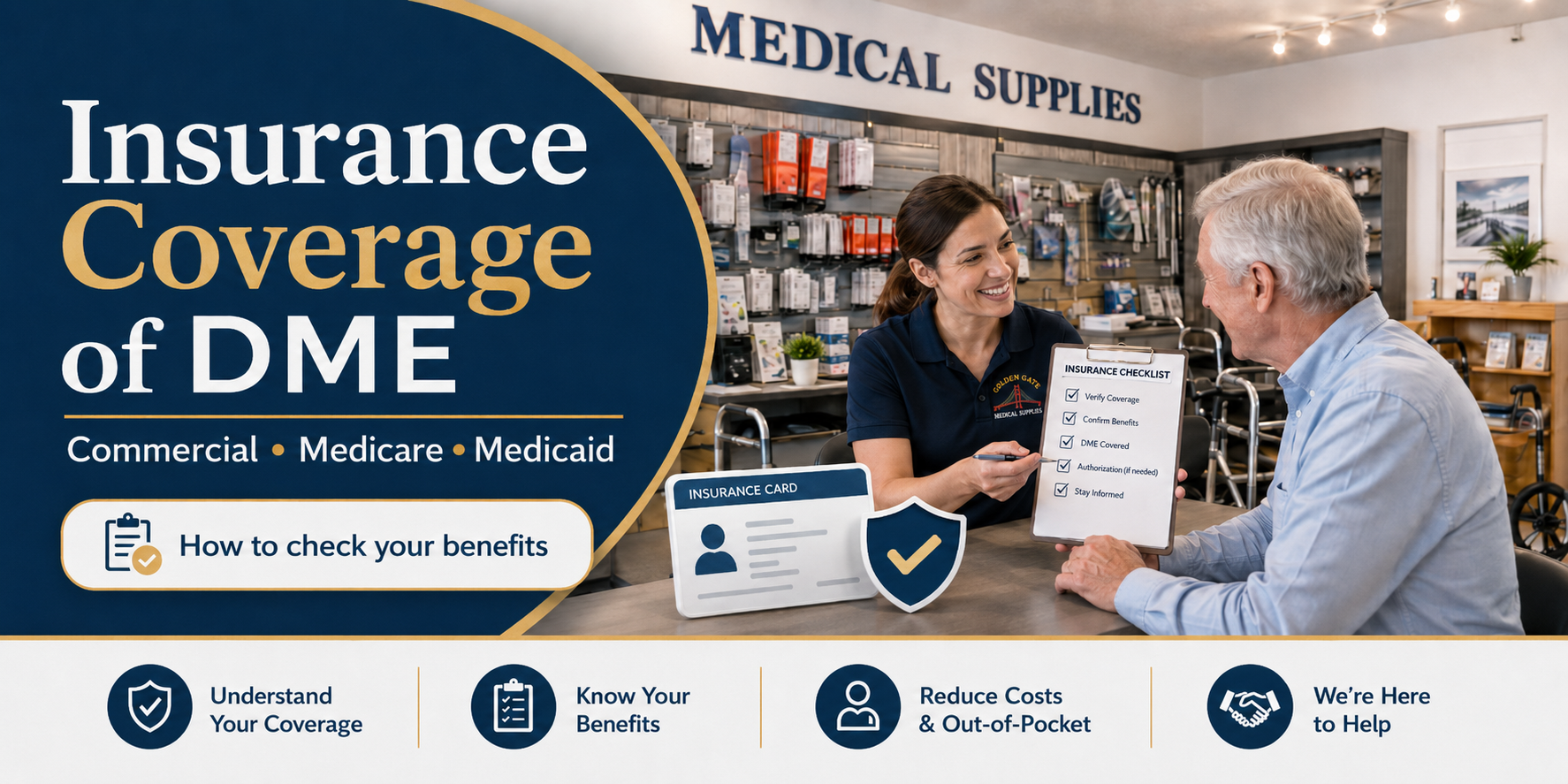
Insurance Coverage Checklist
Gathering basic information before contacting a DME supplier can make verification faster. Not every request requires every document, but the following is a useful starting point.
- Patient’s full name and date of birth
- Current address and phone number
- Front and back of every insurance card
- Medicare Beneficiary Identifier when applicable
- Medicaid identification number when applicable
- Name and phone number of the prescribing provider
- Name of the requested equipment or supply
- Signed prescription or written order
- Recent clinical notes related to the request
- Diagnosis information
- Expected length of need
- Measurements when relevant
- Current equipment being used
- Date similar equipment was last received
- Reason replacement is needed
- Planned hospital or facility discharge date
- Whether delivery, setup, fitting, or education is required
Providing accurate information at the beginning reduces repeated calls and prevents the supplier from reviewing the wrong plan or product.
Questions to Ask the Insurance Company
Insurance member services can help clarify benefits and network requirements. Ask about the exact product rather than relying on a general DME benefit description.
Useful questions include:
- Is the requested equipment or supply a covered benefit under my plan?
- What HCPCS code does the plan use for the item?
- Must I use a particular DME supplier?
- Is Golden Gate Medical Supply in network for this product category?
- Does the item require prior authorization?
- What clinical documentation is required?
- Does the plan rent or purchase the equipment?
- What deductible, copayment, or coinsurance applies?
- Is there a preferred brand or standard model?
- Are upgrades excluded?
- What quantity or replacement limits apply?
- When was a similar item last billed under my policy?
- Does another insurance company need to pay first?
- What appeal rights are available after a denial?
- Where can I find these requirements in my plan documents?
Record the date, representative’s name, and reference number when available. The DME supplier may still need to complete its own verification and documentation review.
A Call Script for Checking Coverage
Patients and caregivers can use the following script when contacting a medical supply company:
“I need help determining whether my insurance covers a name of equipment or supply. My insurance is plan name, and I also have secondary insurance, if applicable. My provider is provider name, and the item is needed because brief explanation. Can you tell me whether this is within your product and insurance scope, what documentation you need, whether prior authorization is required, what my estimated responsibility may be, and what the expected process looks like?”
For a planned discharge, add:
“My expected discharge date is date. What information should the hospital or prescribing provider send now so the request can be reviewed before discharge?”
The supplier may need the actual insurance cards, order, and clinical records before giving a final response. The initial conversation should still clarify whether the company is an appropriate place to begin.
When Golden Gate Medical Supply Is Out of Network
Golden Gate Medical Supply participates with a limited selection of commercial insurance plans. We cannot verify or bill every plan, even when we carry the requested product.
When a request falls outside our credentialed insurance networks, we may recommend that the patient contact the insurer for an in-network DME supplier. Choosing an appropriate in-network provider can reduce unexpected costs and simplify authorization and claim processing.
We may also be able to:
- Explain which type of supplier the patient needs
- Direct the patient to another local or national provider
- Discuss a cash-pay option
- Accept an eligible HSA or FSA payment
- Identify another product within our scope
- Explain what information to request from the insurance company
- Help distinguish between insurance noncoverage and a supplier-network issue
A referral to another supplier does not mean that the requested equipment is unnecessary. It means another company may be better positioned to provide the product through that insurance plan.
What Happens After You Submit Our Coverage Form
Patients and caregivers can submit a request through the Golden Gate Medical Supply coverage-check form. The form creates direct correspondence with our team so we can review the basic request.
The process generally includes:
- Reviewing the requested equipment or supplies
- Determining whether the product falls within our service scope
- Reviewing the insurance information provided
- Determining whether the plan is within our credentialed networks
- Contacting the patient for missing insurance, provider, or prescription information
- Explaining the documentation and authorization requirements
- Discussing possible patient responsibility
- Explaining delivery, shipping, setup, or education requirements
- Directing the patient to another supplier when that would be more appropriate
Submitting the form does not guarantee insurance coverage or product availability. It gives our team enough information to begin evaluating whether and how we may be able to help.
How Golden Gate Medical Supply Can Help
Golden Gate Medical Supply helps patients and caregivers navigate equipment and supply requests involving mobility aids, wheelchairs, hospital beds, patient lifts, ostomy products, urological supplies, incontinence products, wound care, compression products, breast pumps, and maternity supplies.
Our insurance-covered work primarily serves Colorado patients, while our Medicare enrollment footprint allows us to evaluate certain qualifying requests throughout the NPE West region. Eligible cash-pay products may be shipped more broadly when the item can be safely supplied without local fitting, assembly, installation, or patient education.
We cannot provide every product or bill every insurance plan. When the request is outside our scope, our goal is to communicate that clearly and help the patient identify a more appropriate direction whenever possible.
The Best Way to Know Whether Your DME Is Covered
Insurance coverage of DME comes down to the exact item, billing code, medical documentation, plan benefit, supplier network, authorization status, replacement history, and patient cost-sharing. No single insurance card, prescription, or product description answers every part of that question.
Start by gathering both insurance cards, the prescription, recent medical notes, and information about the requested product. Contact a qualified DME supplier early—especially before a hospital or facility discharge—and ask what remains before the order can be submitted or dispensed.
When insurance does not cover the item, ask about alternative products, appeals, another in-network supplier, cash pricing, and eligible HSA or FSA payment. Noncoverage may change who pays for the product, but it does not always eliminate the patient’s ability to obtain it.
- HealthCare.gov Health Insurance Glossary
- Medicare Durable Medical Equipment Coverage
- Medicare Coverage of DME and Other Devices
- CMS DMEPOS General Documentation Requirements
- CMS DMEPOS Prior Authorization
- CMS Durable Medical Equipment Replacement Guidance
- Health First Colorado DMEPOS Billing Manual
- Health First Colorado DME HCPCS Codes
- Health First Colorado General Provider Information Manual
- IRS Medical Expense and HSA/FSA Guidance
- Colorado Medical Sales-Tax Exemptions
- National Provider Enrollment West Region